

Weeds
Posted by mynormas on November 18, 2011
Most people don’t pay too much attention to those grasses that don’t seem to belong to the rest of the grasses surrounding them. The reason being those grasses doesn’t usually impose themselves on people. Other than aesthetics that is. Even if the grasses seem – at first glance – to be similar, there is that slight difference in colour, texture or something that makes people dislike.
What are these grasses? How did they come to be where they are? Why are they left alone? How do we get rid of them? Should we get rid of them? What are they called?
They are called – other than the colourful names some people use to describe them – weeds.

A weed is defined as a plant that grows where it is not wanted. So, because of the definition, a rare black orchid growing in the middle of a fairway would be attacked by changkul-wielding workers before we can finish saying “Rare black orchid is a weed?” Similarly, a banana plant three feet from the pin on a green is a weed, never mind the nutritional qualities of a banana.
Weeds are transplanted in many ways. Assuming a particular golf course or field or taman is constructed, planted and maintained to perfection (this would presumably be on Planet Krypton), weeds can be transported by wind, animals, water, humans or machinery. Sometimes it could also inadvertently be transported by the maintenance staff when they borrow a machine or equipment from another place. This does not only necessarily mean from one golf course to another, but also from one hole to another in the same golf course.
Why Weeds Happen – During Construction.
You would think that no one would plant a weed on their field. No one intentionally would; but sometimes that’s what happens when the owner/manager purchases new planting material like seeds, stolons or sods. To cut cost the planting material might be purchased from the nursery that gave them the lowest quote. Chances are that these nurseries may not apply the best management practices to ensure weed-free materials. How else can they quote so cheap?

Are they planting pure grass stolons are are there weeds seeds mixed in? Did you check? By now, can anyone check?
What some nurseries do is to regularly mow their plots to keep most weeds down to the same height as the surrounding grasses. And when they smell a potential sale, they do a hurried manual weeding job before the buyer’s representative arrives for an inspection visit.
For golf courses, this may be the same scenario if we get our planting material – especially in big quantities – from the award-winning golf course that our boss has friendly relations with. You don’t think they will rip off their best greens and fairways to give us the stolons do you? You might as well ask for their right arm. We may get away with getting the stolons during their renovation works like hollow-tining or verti-cutting. Just be aware that it’s almost impossible to be weed free on all 18 holes (we are not on Planet Krypton) and a verti-cutter machine going on a weed the size of the palm of your hand will create hundreds of tiny baby weeds waiting to sprout on the golf course.
Actually, the story can begin long before the first planting material is purchased. It starts when the soil is being prepared for planting. When the earth was pushed to make way for a golf course, or when the soil is expertly shaped waiting for the planting of the seeds or stolons of the chosen species of grass, it contains planting material of many different species of plants. Each and every viable seed is a potential weed waiting for the right time to sprout.
There are, of course ways to treat the soil – from simply turning the soil over to expose the seeds to sunlight to the complex way of covering it with plastic sheets and injecting it with chemicals – which, by the way, should only be done by licensed applicators.
If you are planting your own field/lawn visit the nursery, ask the supplier to show you which part of nursery they want to harvest for you, then on planting day, insist that they do NOT harvest before you or your rep being there. You don’t want them to show you one part of the nursery then harvest from another part to plant in your field/lawn.
Why Weeds Happen – During Maintenance
As so often is the case, an ill-advised attempt at cost reduction is usually the root cause of many evils when aesthetics is one of the performance indicators. You will hear me repeat this line often: nothing is free in this world; we will pay for it one way or another. Maintain the grass poorly, it will not grow well and, in this instance, will provide an opportunity for weeds to move in. We will eventually spend money to remove the weeds from the golf course. This paragraph will still hold true when I write about disease or pests in the golf course in future articles.
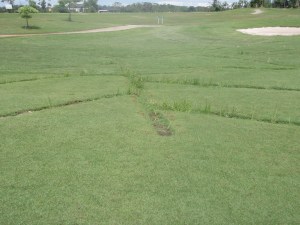
Poor maintenance can cause weeds, this drainage line was left open. So weed came in.
In short; do not expect the maintenance staff to cut costs to the point the grass’ health suffers. Starve it if you must. But make it suffer it you mustn’t.
In the quest for being environmentally friendly, some golf courses used organic fertilizers to feed their grasses. Now, these organic fertilizers are good food for the soil as much as it is good for the grass, but if we calculate on the amount of nutrient it can deliver, it may prove to be quite expensive. Fertilizer made from organic products that are not properly treated may contain weed seeds. Chicken dung and other animal waste or even products made from plant waste may be contaminated at source or during the process to turn it into plant food.
There is a legend of how a Superintendent of a golf course placed an order of several tons of processed chicken dung fertilizer. The purchasing clerk, who with good intentions, believes that all chicken dung are alike proceeded to buy the cheapest one available. The cost of weeding the golf course in the months afterward probably is much higher than the savings on the purchase of the fertilizer.
Weeds can occur in places where there is compaction, such as high-traffic area. Or wet/damp areas. Or dry sandy areas. Different weeds will thrive and specialise in different areas.
The Cure
So now you know where weeds has its roots (pun intended) and you want to roll up your sleeves and ask your maintenance staff on how you can help fight this scourge on the grass field.
How does the staff take care of the weeds? He/she has quite a few things in his arsenal. First and foremost are the mechanical means, which includes sending an army of labourers digging up the weeds with small screwdriver-like implements. It works to a certain extent; at the very least it controls the population of the weeds. More often than not, the staff may miss out the small ones or neglect to dig up the roots which may sprout again. But if you have the budget, this would be one of the best ways to get rid of them.
Another option would be to use chemicals. And there are plenty of chemicals; ranging from those to be used before the weed seeds germinate – called pre-emergent – to those designed for use on living weeds – called post emergent. Most weedicides or herbicides, for this is the category the chemicals used to kill weeds is called, belong to the post-emergent type.
More often than not, the staff will choose a ‘selective’ herbicide; these are the chemicals that may spare the original grass and kill a certain type or family of weeds. The danger is that if the wrong mixture or rate is used, it may kill the original grass itself. You might also note that even if it doesn’t kill the original grass, there may be a slight discoloration that will be visible for a week or two. The opposite of a ‘selective’ herbicide will be a ‘kill-all’ herbicide, for want of a better word.
The staff can also choose to use either a contact herbicide that will kill the weeds it is supposed to on contact or he can choose to use a systemic one, which will be absorbed through the plant and start to kill from within. If he chooses a contact, he may need to use a reliable sprayer so that full coverage can be effected. Otherwise, the herbicide may only kill parts of a grass instead of all of it.
Please be reminded that all the above information is only a fraction of a branch of knowledge used by maintenance staff. For more information regarding herbicides in particular or weeds in general; get in touch with me.
 Turf Matters
WD said
I have a problem with weeds AND lawn caterpillars. The worst thing is, the caterpillars selectively eat only my philippines grass, not the weeds. Any recommendation on how to get rid of them? The nurseries recommend carbofuran.
LikeLike
mynormas said
Sorry for the late reply.
The caterpillars only eat the Philipine grass? That’s new. Zoysia grass – of which I thought PG is a part of – is usually too tough for insects. Hmmm… but the problem with common names is someone’s Zoysia is someone else’s Bermuda.
No, don’t use carbofuran – ever. Ever ever.
You can try nicotine (i found this tip in the latest Laman magazine Nov 2011) found from tobacco and coffee powder. Or you can also use normal household insecticidal spray; find the water-based one. Before you spray; mix a little bit of dishwashing liquid with water (about a spoon in a bucket) and throw it into your grass. The caterpillar should start coming to the surface because the soap will irritate them. Thats when you spray the insecticide. Don’t do this when the sun is shining coz they won’t come up.
The caterpillars are larvae of moths/beetles so they will come in cycles. Do it when you see a lot of them and then repeat a week later then another week.
Best of luck!
LikeLike
WD said
Such is life. Your reply came too late. I unleashed a kilo of carbofuran on to my lawn. Thankfully, no birds died. As far as I can see….
Before I went for the carbofuran, I actually spent 2 cans of water-based Ridsect. There were just too many of them. I have to say, the caterpillars are very tough. I could still spot many of them around, after 2 days. I am not sure if you are familiar with the species. They are black and hairy, with a single yellow stripe along the length of the body. They move very fast, and they eat faster. In half a week, they ate half my lawn.
My zoysia was growing very fast due to the wet weather recently. Also, they were growing straight up due to the lack of sunlight. I have a huge tree beside my house, and yes, I planted zoysia before I read your advice on shade tolerant grass… That is another disaster…
LikeLike
mynormas said
Ooh… I guess I should’ve replied earlier too. Sorry.
Don’t worry about the birds, the biggest danger (in my experience) with carbofuran is to fishes and humans. After I applied carbofuran on my turf, there was heavy rain and I think I spent about a week cleaning up dead fish in my ponds. Another time, I had to drive one of my workers to the ER because he was having complications while applying carbofuran (yes he was wearing safety equipment). Both happened more than 10 years ago and I have stopped or avoided using carbofuran as much as I can on turf.
Carbofuran is a systemic insecticide, which means it will be absorbed by the plant and will make the plant dangerous for anything that eats it. You may have noticed the granules on the ground between the grass a few days after applying. It does not breakdown or absorbed quick enough.
Ok, its the past and it should keep your lawn pest free for about a month, provided the plants have enough time to absorbed the ingredient before it gets washed away. So anyway, the Ridsect by itself won’t work on the insects (yes even though they have more than 6 legs, they are larva of insects) and from your description sounds like what we call ‘sod-worm’. Its trickier than army-worm (green colour) because they are below surface level. Their cuticle will protect them from the water-based Ridsects. The soap-water, if applied beforehand will help in removing the waxy cuticles, on top of bringing more of theses dastardly insects to the surface. You could try normal Baygon or Ridsects, they are oil-based and would defeat the waxy surface, but try not to overspray because it may affect the leaves of your turf or other plants.
Again, insects like these come in cycles (more accurately; phases) of egg, larvae, pupae and adult. Most insecticides – including Carbofuran – will only affect the larvae and adult stage so at around 7-10 days, the eggs will hatch or the pupae will spawn a new generation of adults which will lay eggs at your lawn again so keep an eye out for the next generation. If the carbofuran were absorbed, you should not need to do anything else beyond cleaning up the bodies after their death.
As for the Zoysia, its the most common problem among houseowners. what you can try to do now is to prune as much branches as aesthetically and reasonably possible from your trees and go for more sunlight. You could also, divide your lawn into a few sections, one with Zoysia and another with Cow/Pearlgrass or even shade tolerant shrubs like “Rheo discolor” etc or even hard lansdcaped it with tiles, etc.
Much as I dislike the use of chemicals in the household; I must say that a better choice than carbofuran (which – if memory serves me right – is a Class III poison) is the use of a Class IV insecticide (brand names escape me at this moment but your supplier would know). And you could use those small 1 litre container which you should label with the word “POISON” and never ever store chemicals in mineral water or containers other than the original bottle. Your Ridsect and Baygon will have a white band at the bottom of the can with the words Class IV Poison too.
Forgive my rambling. Must be the guilty conscience talking.
LikeLike
Zack said
I posted on Oct 1 under “Masalah Rumput” and wanting to use the herbicide to kill all the weeds in my lawn. Now I manage to buy “Weed B Gon Max” from Ortho in USA that kills weeds not lawns. I just bought it in USA last week. Below is the web link fyi:
http://www.scotts.com/smg/catalog/productTemplate.jsp?proId=prod70196&itemId=cat50064&icid=hp1_mm_p_owk
However, at the back of the bottle there is a note “Environmental Hazards” which the 2nd point concerns me:
“Dont apply directly to water, when cleaning equipment do not pour washwater on the ground, spray or drain over a large area away from well..”
This note scared me for life. Because I can cause polution to the nearby and since I have small children it may harm the health of my baby running around on the lawn etc.
Now I am thinking twice to use or not, even though I was so excited to kill the weeds after coming back from USA. But I think I should use the traditional method rather than herbicide since I have small kid in my house.
So may I get your advice whether should I proceed spraying Weed B Gon Max from Ortho. If I do, what some of the precautions should I take.
Thanks
LikeLike
mynormas said
Dear Zack,
I have a certified safety officer certificate and I train golf course maintenance teams on how to spray chemicals. I teach them to use PPE (personal protective equipment) even when spraying ‘harmless’ fertilizers.
Scotts’ website does not show me the a.i or active ingredient so I don’t know what it contains. Malaysian pesticides will have a colour band at the bottom of the bottle to signal the level of danger it pose to the user (go ahead, take out your Baygon, H2O or whatever insect spray and look at the bottom, it will have a white band with the words ‘KELAS IV’ which means it is the least poisonous – comparatively speaking).
Scratch the 1st line of the above para. I just saw the active ingredient. MCPA? Pretty strong stuff in my experience. It falls under the category of a hormone. But I think in 2004 the US EPA allowed it to be used for house lawns.
Sorry man, you are on your own. I don’t even know how to tell you to get rid of it. Sorry, but I’ll stick to giving advice about grass only, not chemicals thru a blog post answer or through the internet, for that matter. Read the directions on the label. Surf the net.
And please don’t throw it with the trash. Pass it to the nearest golf club with a note that it be used by their golf course superintendent if you want to get rid of it. Or find Scotts distributor in Malaysia and return it back to them. I doubt they know how to use it too.
LikeLike
Jeffrey Ng said
Hi Zack,
I’ve been trying to find it locally but to no avail. Online stores won’t ship to Malaysia. Even if they did, the shipping cost is way too expensive.
Anyway, have you used it? Any good? If you are not going to use it, I would like to purchase it from you.
LikeLike
Marini said
Help! We are our wits end regarding the abundance of %#^*}# weeds in our garden. Our garden is not quite the size of a golf course (thank goodness) but its relatively sizeable for today’s standard postage stamp size lots. Abt 3000 square feet. The weeds! I can’t stand the sight of them and together with my bibik and our kuku kambing-like tool we’ve been ‘cabuting’ and as soon as we’re done (ie our backs giving way), it starts growing again. Hubby now is dreaming of just concretizing or nuking the whole garden… yikes! Other than Roundup (the killer of all things green -boo!), what other racuns can we use? We have the Zoysia Japonica variety (me thinks). We also have relatively poor quality soil, poor irrigation -the works. AND we have a natural spring (not kidding – Perrier anyone?) at one corner which causes the soil to be perpetually wet with sparse sickly grass but super healthy weeds (daun bulat bulat – shilling or quarter sized leaves), amongst many others. Our gardener’s solution has been to just mow the lawn…which to me makes the weeds spread faster. So yes… HELP! Need the name of the selective racun for zoysia or any other solution….
LikeLike
mynormas said
Puan. This is the first time I enjoyed reading a question. From the description, sounds like you are being over-run by broad-leaved weeds (its a classification) and the selective herbicide for it is… well, before I give you the name, since I dislike the use of chemicals by untrained amateurs (no offence intended) let me see if we can solve the problem another way.
Broad-leaved weeds usually thrives in areas where there are insufficient sunlight, since because of the size of their leaves, they can make optimum use of the little sunlight available. So look at trimming the shrubs or trees surrounding.
Another problem you face is that – ahem – spring water that gushes forth even when you are not exactly in need of it, so other than setting up your own bottling plant, you may need to install a subsoil drain straight from the source to the nearest drain. Or you could make a fountain? Hmm… anyway, the weeds that grow in these wet areas usually are sedges; ugly-looking flowers when you let them grow longer than one week.
There’s something else that I wanted to tell you … now I forgot.
Aah, maybe you should consider redecorating? You know, those areas that are problem areas can be converted to shrubs or ponds (gasp! the spring water!) or perhaps even a different kind of landscape or grass.
Lastly, you could divide your lawn into same sized grids (I literally recommending using strings to divide areas into checker-board like blocks); then give your military-minded husband (and maybe son?) a kuku kambing then say into your kuku kambing *hand over mouth, mimicking radio static* “Bravo team, bravo team, bandit spotted in grid A7, seek and destroy; I repeat; seek and destroy. Do you copy. Over” *mimicking radio static again*. Ok seriously; one problem with amateurs (not you! Those other people) doing hand-weeding is that they weed all over the place, which means that the little bit left in the area they already weeded, will spawn more weeds. They will hand-weed it again, doing the same mistake and then lose hope. So before I read in the papers about some lady hanging herself from her Bougainvillea tree; use the grid to concentrate the fire-power of your weeding in one area before moving to the next. Maybe to make the job more glamorous for you, maybe you could dress like the late Lady Diana while she was looking for land mines in Africa?
Ok finally, the weedicide that we usually use (and if I remember correctly it is a Class IV poison; like Baygon. BUT IT IS STILL POISON) are Almix for both broad-leaf and sedges. Or Ally just for broad-leaf. There’s also Monument (expensive). We use MSMA too but the ‘A’ stands for arsenic so I wouldn’t recommend it for amateurs (theres that word again! Who are these people?). ‘Image’ is another brand name you could use, but also expensive and does ‘burn’ though not kill your Zoysia if over-dose. And puan? Don’t ever forget to read labels. Each and every time. Keep the labels on the bottles, never storing it in other types of bottles even temporarily. Also take note that the labels will have the antidote written on it for emergencies.
Selamat mencuba!
LikeLike
tudung online said
Hello, I desire to subscribe for this webpage to obtain newest updates, therefore
where can i do it please help out.
LikeLike
mynormas said
Puan, thank you for your interest. At the top of the page, right hand corner: there is a follow button. Just click it an dfollow instructions.
LikeLike
lim said
Hi sir. I just planted philippines grass ( Zoysia matrella ) in my lawn 2 months ago . And now i see lots of weeds here and there . Im tired of hand weeding the lawn which is about 3500 sq feet . Im planning to get Monument ( Herbicide ) . Can i know where to buy it in Kuala Lumpur???
LikeLike